National Education Policy
New Education Policy was launched on Wednesday, July 29. Earlier, in the afternoon the Union cabinet approved the policy that aims to overhaul the country’s education system. Union Ministers for Information and Broadcasting (I&B)Prakash Javadekar and Human Resource Development (HRD) and Ramesh Pokhriyal Nishank, made the announcement on the NEP- 2020. Earlier on May 1, Prime Minister Narendra Modi had reviewed the NEP- 2020, for which draft was prepared by a panel of experts led by former Indian Space Research Organisation (ISRO) chief K Kasturirangan.
New Policies
Board Exam
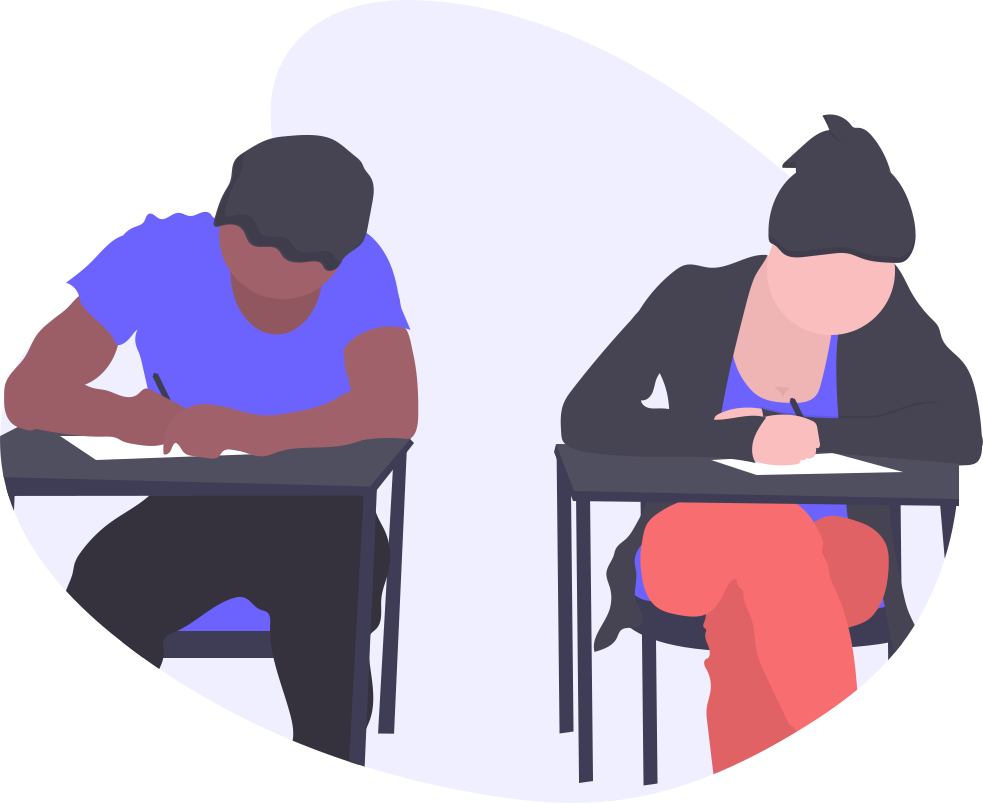
In order to reduce the importance and stress of board exam, exam will be conducted in two parts: Objective and descriptive. Exam can be conducted twice a year. Board exam should promote knowledge application rather than rote learning, she added.
View more
Vocational Studies
Sampling of important vocational crafts, such as carpentry, electric work, metal work, gardening, pottery making, etc., as decided by States and local communities during Grades 6-8. By 2025, at least 50% of learners through the school and higher education system shall have exposure to vocational education A 10-day bagless period sometime during Grades 6-8 to intern with local vocational experts such as carpenters, gardeners, potters, artists, etc.
View more
Indian Sign Language
NIOS will develop high-quality modules to teach Indian Sign Language, and to teach other basic subjects using Indian Sign Language.
View more
Kendriyas Vidhalaya
Pre-school sections covering at least one year of early childhood care and education will be added to Kendriya Vidyalayas and other primary schools around the nation, particularly in disadvantaged areas.
View more
NCC
Under the aegis of the Ministry of Defence, State Governments may encourage opening NCC wings in their secondary and higher secondary schools, including those located in tribal dominated areas
View more
Online Learning
A dedicated unit for the purpose of orchestrating the building of digital infrastructure, digital content and capacity building will be created in the MHRD to look after the e-education needs of both school and higher education. demics and pandemics in order to ensure preparedness with alternative modes of quality education whenever and wherever traditional and in-person modes of education are not possible.
View more
Ciurricular Structure
The extant 10+2 structure in school education will be modified with a new pedagogical and curricular restructuring of 5+3+3+4 covering ages 3-18. Currently, children in the age group of 3-6 are not covered in the 10+2 structure as Class 1 begins at age 6. In the new 5+3+3+4 structure, a strong base of Early Childhood Care and Education (ECCE) from age 3 is also included.
View more
Streams
Students will be given increased flexibility and choice of subjects to study, particularly in secondary school - including subjects in physical education, the arts and crafts, and vocational skills There will be no hard separation among ‘curricular’, ‘extracurricular’, or ‘co-curricular’, among ‘arts’, ‘humanities’, and ‘sciences’, or between ‘vocational’ or ‘academic’ streams. Subjects such as physical education, the arts and crafts, and vocational skills, in addition to science, humanities, and mathematics, will be incorporated throughout the school curriculum.
View more
Experimental Learning
Experiential learning will include hands-on learning, arts-integrated and sports-integrated education, story-telling-based pedagogy, among others, as standard pedagogy . Classroom transactions will shift, towards competency-based learning and education
View moreGet in touch.